
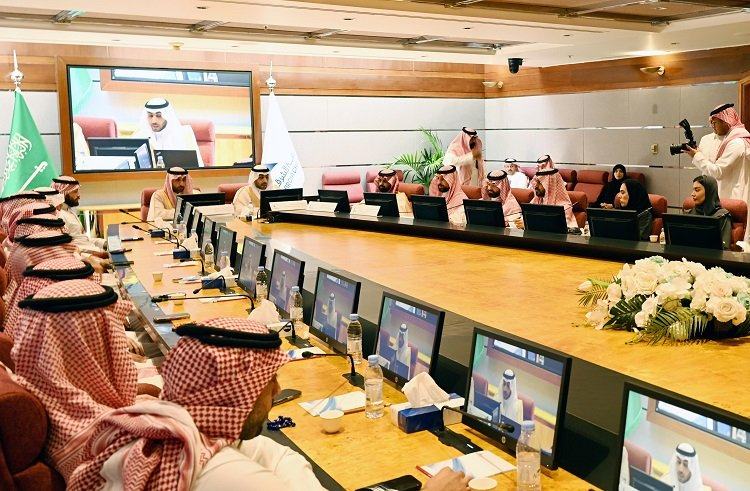
Asharqia Chamber organized on Thursday, May 14, 2026, a meeting between the CEO of the Eastern Province Development Authority, Dr. Talal bin Nabil Al-Maghlouth, and the business sector in the region, in the presence of Chairman of Asharqia Chamber’s Board of Directors, Fahad bin Abdullah Al-Farraj, and a number of investors, entrepreneurs, specialists, and interested participants.
The meeting was held to discuss the Saudi Architecture Initiative in the Eastern Province, which was launched by HRH the Crown Prince and Prime Minister during the first quarter of 2025.
The CEO of the Eastern Province Development Authority, Dr. Talal bin Nabil Al-Maghlouth, affirmed that the Saudi Architecture Initiative, launched by His Royal Highness Prince Mohammed bin Salman bin Abdulaziz, Crown Prince and Prime Minister, may Allah protect him, represents an extension of the Kingdom’s cultural and urban identity, and contributes to building modern cities that reflect the spirit of place and its authentic details. He noted that the Eastern Province embraces four architectural styles that reflect its natural and cultural diversity.
Al-Maghlouth indicated, during his speech at the meeting, that the studio is working to apply the architectural styles under the directives of His Royal Highness Prince Saud bin Naif bin Abdulaziz, Governor of the Eastern Province and Chairman of the Authority’s Board, and the follow-up of His Royal Highness Prince Saud bin Bandar bin Abdulaziz, Deputy Governor of the Eastern Province, Vice Chairman of the Board and Chairman of the Executive Committee. This confirms their continued keenness to carry on work according to high-quality standards that contribute to enhancing the urban landscape in the Eastern Province, thereby raising the quality of life for citizens, residents, and visitors.
He explained that the Eastern Design Studio serves as a technical arm to activate the Saudi Architecture Initiative by applying design guidelines, improving the quality of urban outputs, and strengthening partnership with government entities and engineering offices. He affirmed that the success of Saudi architecture is not achieved through regulations and guidelines alone, but through partnership and integration among all parties, and through our ability to transform urban identity into added value reflected in quality of life, the urban landscape, and the human experience in our cities.
Al-Maghlouth said, “The initiative embodies a vision that seeks to build modern cities that reflect the spirit of place and its authentic details. The Saudi Architecture Initiative represents more than merely a visual character or formal treatments; it is a language that expresses the history of society, the specificity of the environment, and the lifestyles that have formed over time across the various regions of the Kingdom. From this standpoint, the Saudi Architecture Map came to include 19 architectural styles linked to the geographical and cultural scopes of the Kingdom, away from administrative division.”
For his part, Chairman of Asharqia Chamber’s Board of Directors, Fahad bin Abdullah Al-Farraj, explained that the architecture sector comes as one of the promising economic drivers within the objectives of Vision 2030, by contributing to shaping a renewed national architectural identity. He affirmed that this architectural identity draws its authenticity from the Kingdom’s long-standing history and benefits from today’s technologies to present a Saudi architectural model with global standards.
Al-Farraj indicated that the business sector does not view “Saudi architecture” merely as an engineering style, but rather as an integrated investment system. He considered that reviving the architectural identity represents a catalyst for further qualitative investments in the sectors of construction, real estate technologies, and local industries related to national building materials, thereby enhancing the added value of national companies.
During the meeting, Director of the Eastern Design Studio, Eng. Mohammed Al-Nomani, delivered an introductory presentation in which he reviewed the key objectives of the Saudi Architecture Initiative and the role of the Eastern Design Studio, affiliated with the Eastern Province Development Authority, in applying design guidelines and enhancing urban identity in the Eastern Province, contributing to raising the quality of the urban landscape and achieving the objectives of Saudi Vision 2030.
The presentation addressed the Saudi Architecture Initiative launched by HRH the Crown Prince, which aims to develop an urban landscape that reflects national identity through 19 architectural styles inspired by the geographical and cultural characteristics of the Kingdom’s various regions.
Al-Nomani explained that the Eastern Province includes four main architectural styles: Eastern Coast Architecture, Qatif Architecture, Eastern Najdi Architecture, and Al-Ahsa Oasis Architecture. He affirmed that the Eastern Design Studio serves as a specialized reference for applying Saudi architecture to government, commercial, and major projects in the region.
He also reviewed the studio’s key roles, which include reviewing and approving architectural designs for commercial, government, and major projects, preparing design guidelines and codes, providing technical consultations and training courses, in addition to raising awareness of urban identity and architectural styles in the Eastern Province.
The presentation also addressed the journey for submitting construction permit applications and the studio’s role upon receiving applications through the “Balady” platform until project approval is issued. It included an explanation of the unified project submission model and the importance of benefiting from the technical consultation sessions provided by the studio, in addition to explaining the three architectural patterns: traditional, transitional, and contemporary, and their connection to the pattern distribution plans within the approved urban scopes. The presentation also included models of developed projects and approved distinguished projects that reflect the application of Saudi architecture in the cities of the Eastern Province.
Al-Nomani emphasized, during the presentation, the need to believe in the strategic dimensions carried by the initiative and that applying Saudi architecture contributes to creating an environment that suits our nature and identity, raises our quality of life, creates an urban landscape, and generates sustainable economic momentum. This is in addition to supporting national competencies and raising the quality of architectural and urban outputs in the region.