At a Meeting Organized by the Asharqia Young Businessmen Council:
Former Deputy Minister of Industry Charts a Roadmap for Young Businesspeople at Asharqia Chamber to Lead Impactful Nation-Building
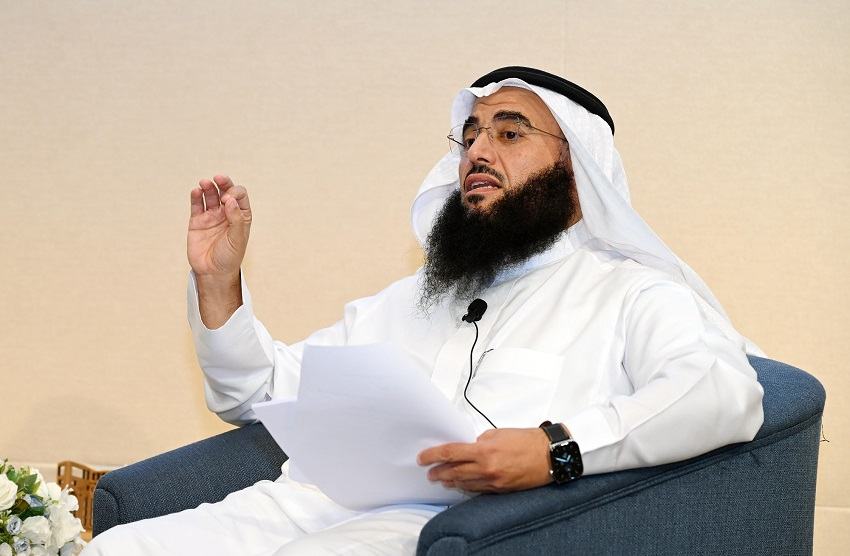
His Excellency Engineer Osama bin Abdulaziz Al-Zamil, former Deputy Minister of Industry and Mineral Resources, highlighted the pivotal role young people play in the private, public, volunteer, and government sectors in promoting comprehensive economic development. He emphasized that family businesses, major corporations, and chambers of commerce provide a true training ground for honing leadership skills and establishing the principles of governance and discipline.
He made these remarks during his participation in the “My Experience” program, organized by Asharqia Chamber, represented by the Asharqia Young Businessmen Council, on the evening of Wednesday, October 21, 2026, at the Chamber’s headquarters. Al-Zamil shared key milestones from his professional career, which spans nearly 30 years, beginning at SABIC, continuing through his leadership roles at Zamil Group Holding, his chairmanship of the National Industrial Committee, and his service as Deputy Minister of Industry and Mineral Resources, and culminating in the establishment of his consulting venture, Awaz.
During the meeting, attended by Asharqia Chamber Chairman of the Board of Directors Fahad bin Abdullah Al-Farraj; Chamber Board Member Abdulrahman bin Mohammed Al-Bassam; Secretary-General Abdulrahman bin Abdullah Al-Wabel; Asharqia Young Businessmen Council Chairman Rami bin Saleh Al-Sayed; and a number of businesspeople, entrepreneurs, and other interested attendees, Al-Zamil discussed his early career at SABIC after graduating from King Fahd University of Petroleum and Minerals as an industrial engineer and earning an MBA in the United States. The discussion was moderated by Nasser bin Saleh Al-Shehri. He noted that working at SABIC offered an opportunity to benefit from the wealth of leadership, culture, values, and strong sense of national spirit at the company—a precious asset embodied by its distinguished leadership. SABIC was also a school of corporate professionalism for him. He began with marketing analysis, then business analysis, and learned about enterprise resource planning systems and decision support. He also learned that data is not merely a set of reports, but a tool for understanding reality and improving decision-making. He learned that good decisions require accurate, reliable information, and that organizational structure helps sustain outstanding performance.
Regarding work in family businesses, Al-Zamil described his experience as the son of an executive owner and a third-generation member of Zamil Group Holding. He stressed the importance of prioritizing values over systems in family businesses, noting that the most important family values include equality, honesty, fairness, and humility. He also emphasized that “decision-making in family businesses carries a double responsibility,” given its connection to the family’s reputation and assets. He recalled the invaluable advice he received from his late uncle, Hamad Al-Zamil, on making decisions and exercising authority wisely and thoughtfully. He noted that balancing family ties with corporate governance requires full commitment to family values, separation of ownership from management, and ensuring that family members become “informed, insightful owners” through education and awareness-raising to dispel ignorance and lack of understanding, and to serve as role models in discipline and accountability.
He also explained that after leaving government service, he chose to establish Awaz Consulting to put his extensive experience to sustainable use by targeting promising, knowledge-based sectors under Vision 2030, applying development methodologies, facilitating investment, and building support through positive collaboration across the three sectors: private, public, and volunteer.
His Excellency Engineer Osama Al-Zamil offered a range of practical recommendations to help young businesspeople create impact and achieve sustainable success. He stressed that getting out into the field and mastering and understanding operational details, systems, and regulations early in one’s career are essential to protecting a project from collapse during crises. He noted that a leader’s role is to monitor conditions on the ground and motivate employees without directly intervening in how the work is carried out.
Al-Zamil also advised young people to invest in building social capital and relationships by fostering connections grounded in integrity, transparency, and good conduct. He emphasized that ethical management principles are what balance people’s rights with self-interest. He also highlighted the importance of focusing on solutions through the 80/20 rule: devoting 80% of one’s time and effort to developing solutions and initiatives, and only 20% to identifying opportunities and diagnosing challenges and problems, to ensure time is used efficiently.
His Excellency Al-Zamil urged entrepreneurs to create an attractive, positive work environment for teams working alongside young leaders. One of the tools he recommended was the “feedforward” approach: looking ahead and learning from daily practices to ensure teams continually improve, rather than dwelling on negative criticism of past mistakes. Al-Zamil also underscored the importance of every entrepreneur seeking advice from experienced people, setting goals, and choosing a trusted leadership mentor and a wise personal confidant to consult at important turning points. He stressed the need to set clear life and career goals and to begin each day with a positive, realistic, and optimistic outlook.
The meeting concluded with Al-Zamil affirming that integrity, commitment to values, and clarity of purpose are the solid foundation that enables entrepreneurs to persevere and grow, and to turn operational challenges into development and investment opportunities that contribute to building the nation.